

TL;DR
Attention Insight is a design-desk heatmap tool from a technology background. Credit-based plans from €29 to €299 per month, where one credit buys one image, one URL, one (general) AI recommendation, one second of video, or four API transactions. They have a strong plugin coverage (Figma, Adobe XD, Sketch, Chrome), built for designers and small teams doing pre-launch visual design checks.
Brainsight is an attention insights & intelligence platform for advertising and UX/CRO. Coming from a neuroscience research background (Braingineers, Amsterdam), it focuses on insights: analysis functionalities and (contextual) creative performance. Benchmarks include Contextual Attention, Clarity / Cognitive Load -varying by channel and category- and analyses are built on owned research frameworks. It has extensive video heatmap options, brand- and key message tracking, and an API built for scale (thousands per day). Pricing is transparent: no credits, no meter.
Need fast visual validations at a design-desk price? Attention Insight does that well. If you require deeper insights and analyses for teams whose work carries marketing and media budget: that is what Brainsight is built for.
Brainsight vs Attention Insight
Brainsight and Attention Insight are both platforms that predict visual attention and generate AI heatmaps. That is where the overlap ends. The tools differ in origin, in what surrounds those heatmaps (scores, benchmarks, interpretation), in pricing-strategy, and in who they are built for.
This guide explains what the differences are:
1. Different origins, different platforms
Attention Insight comes from a technology background. The team built a capable attention model on public eye-tracking datasets and turned it into a fast, accessible product with strong plugin coverage. Credit where due: if you need quick heatmapping and visual checks, they do that well, at a price built for exactly that.
Brainsight has a different origin: neuroscience and live research into advertising and UX/CRO for large brands. It grew out of Braingineers, the Amsterdam neuromarketing agency and lab that ran thousands of eye-tracking (Tobii) and EEG studies for clients like dentsu, Omnicom, Asics, Visa, Adyen, ABN Amro and Vodafone, and was the first in the Benelux to offer neuro-usability solutions. That legacy shapes everything: methodology, data, AI modeling and expertise. The result is three stacked data layers: academic validated datasets at the base, proprietary benchmarking engines in the middle, and proprietary research and scoring logic on top.
The practical consequence: both platforms analyze designs and provide AI heatmaps, but what surrounds them is different. Attention Insight is great for the design desk: quick checks on layouts and visuals. Brainsight is for those who need an intelligence layer that advertising, media and UX/CRO work demands, especially when clients or other internal stakeholders are involved.
2. Pricing structure
Attention Insight runs on credits. This makes sense, considering the pricing of their plans: plans vary: €29 (with watermarked reports) to €119 (Pro, 200 credits) to €299 (Hero). An additional seat is €39 per month. One credit equals one image test, one URL (up to three sections), one AI recommendation, one second of video, or four API transactions. Every action ticks the meter, and heavy months mean upgrade conversations. For example: uploading and analysing one 30-second video would come down to €20.
Brainsight does not run a meter: no credits, no per-action billing, no forced tier upgrades. Extra user this month? Added. Big campaign landed and you ran over your usage threshold? Fine, next month you are probably under it again. We come from a research-agency world, where you are a partner on the account, not a vendor optimizing expansion revenue. It is why our customers stay with us: nobody leaves a tool that never punishes them for using it.
Brainsight's pricing is easy to calculate: see our pricing page here. Entry plans start at €199/month, but agency and brand teams are typically on the €399 or 799/month plans. API cost is either monthly flat fee or at unit-cost; whatever suits your situation best.
3. benchmarks & scores
An AI heatmap shows where attention goes. A benchmarked score tells you whether that is good or not. This is the layer where Brainsight and Attention Insight diverge.
Attention Insight provides three things: a percentage of attention each design-element gets (measured against element averages, like "your CTA is below the 5% average"), a Focus Score for how concentrated attention is, and a Clarity score that flags visual clutter and places your design in fixed bands against a general pool of websites. What it doesn't give you: a benchmarked score for the creative as a whole, or any channel context. A bus shelter poster, a social ad and a landing page are all measured against the same yardstick.
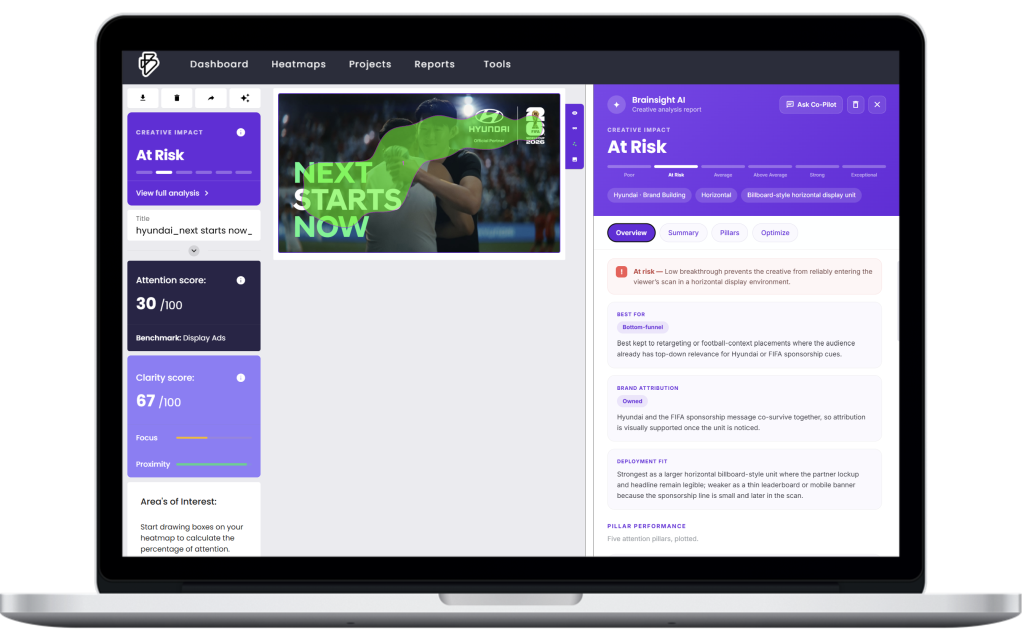
Brainsight does the same with 'Areas of Interest', but provides benchmarked Attention Scores and Clarity Scores (cognitive load) on top; contextual per channel and by type of creative (i.e. display, social, DOOH, print, landing pages). A creative is judged against what it competes with, because "strong" means something different on a bus shelter than in a feed.
For those interested in custom benchmarking, i.e. for their own retail media or outdoor media outlets, Brainsight offers custom benchmarking (project). Roularta, a leading publisher of magazines and online websites is a live example. For publishers this turns every pitch into evidence, offering pre-flight testing solutions for them or their advertisers.
4. Analyses: insights and functionalities
From metrics to meaning: different approaches
Like all platforms, both Attention Insight and Brainsight offer AI-generated guidance on top of their metrics, but the construction differs fundamentally:
Attention Insight offers four fixed AI recommendation prompts (optimize for conversions, attention distribution, design consistency, colors and contrast). Each request sends your design to a third-party service for analysis, consumes one credit, and returns general design guidance. Their own reports carry this note. It is a useful quick opinion, and it is honest of them to label it that way.
General-purpose AI models are probabilistic: run the same creative through them three times and you can get three different recommendations. Brainsight uses fixed, owned research models instead to get the same diagnostics each time.
Brainsight's Deep Audits interpret the underlying data through a proprietary and fixed framework. For advertising this includes Breakthrough, Brand Linkage, Instant Understanding, Cognitive Ease, and Message Take-out. The model has a range of sub-pillars, weightings and goal-contextual scoring and creatives score differently on a Convert goal than for an Inform or Branding objective. For UX it adds Inclusive Design and A/B testing hypotheses.
other analysis- and Insights functionalities
These other functionalities are offered in Brainsight's platform and not found in Attention Insight's heatmap tool:
- Gazeplots: also known as scanpaths; in what order are your design elements intuitively scanned?
- Scrolling Heatmaps for web/landing pages to check natural visual flows and visual hierarchy for UX and CRO.
- Templates: directly show or download your design in its natural environment
- AI Expert (Chatbot): ask direct questions about your creative, its scores or optimization suggestions.
- YouTube Thumbnails: Heatmap your thumbnail in a live (relevant: keywords) feed
- Creative comparison: upload multiple heatmaps and compare their benchmarked scores
- Branded reports: analyses in your branded PowerPoint; ideal for pitches or client analyses
- Extensive Video Heatmap options: see next paragraphs
5. Video Heatmaps
This is where the heatmap capabilities and credit model shows its limits most clearly and where Attention Insight and Brainsight are a world apart.
At Attention Insight, video options are limited. One credit buys one second of video. A Pro plan (200 credits per month) covers 3 minutes and 20 seconds of video analysis per month, if you spend every credit on video and nothing else. Test three edits in two rounds and one campaign consumes nearly a full Pro month, before you have analyzed a single static asset. The Hero plan handles more under a fair-use policy of about 30 minutes per month.
At Brainsight, video heatmaps and analyses are part of the platform. Upload multiple videos, up to 15 minutes per video, no file size restriction, and get benchmarked results, with Deep Audit interpretations and brand tracking on top. At Attention Insight, 15 minutes of video content would consume 900 credits, more than four months of an entire Pro plan.
If you only upload video content occasionally, and when they are short, the Attention Insight model could work for you. If video is part of how you test (TVCs, social video, pre-rolls, YouTube content), you need a platform where the meter is not part of the equation and analyses are extensive.
Finally, Attention Insight does not cover brand tracking in their analyses. See next paragraph on this Brainsight capability.
6. Brand tracking
Attention Insight does not offer brand tracking. Brainsight does, and also goes a step further than most platforms:
Brainsight's Brand Analytics tracks exactly when, where and how long your brand is in view across a video: logo visibility, branded attention, Time Till First Brand, and whether the brand lands within the crucial first 2 and 5 seconds. Object recognition and text recognition combined, frame by frame.
When you are not a leading brand like Coca-Cola, easily spotted by generic recognition models and LLMs, do know that Brainsight has custom logo training so that your regional retail chain, local magazine title, new sub-brand or challenger brand that recently launched, can be tracked as well. Brand sets are prepared before onboarding and new logo additions mid-subscription is ready within 24 hours on average. We don't charge for this: as said, keep our customers happy is part of our partnership DNA.
7. Comparison Table
8. Brainsight or Attention insight?
Five reasons you might choose Brainsight
When choosing Brainsight, these are the main reasons for doing so:
- You need an insights- and intelligence platform
A heatmap shows where attention goes; intelligence tells you whether that is good, and why. Brainsight is built as an analysis and intelligence layer on a neuroscience foundation: layered data, models, benchmarked scores. Various analysis modules and features. Science-based. - You analyze for clients or the board. And it shows
Whether your deliverable goes to a client or lands on an internal stakeholder's desk, it has to hold up. Extensive analyses, professional reporting and substantiated metrics, with whitepapers available to back up methodology when procurement, a CMO or a skeptical stakeholder asks "how does this work?". An analysis is only as strong as its ability to convince the person who wasn't in the room. - You regularly analyse video content
Brainsight offers the most elaborate video options. Flexible in heatmap uploads, benchmarked scores, brand and key message tracked: logo visibility, branded attention, Time Till First Brand. Custom-trained recognition for local and niche brands. TVCs, cutdowns, bumpers and social edits, tested and retested, the same afternoon. - Analyses: you require diagnosis over detection
Audits that read your creative the way a researcher would: through scientifically grounded models and scoring rubrics, weighted for your campaign (or page) goal, ad-type and the creative's context. - You run at scale, the infrastructure breathes with you
On the front end you need workspaces per team, brand, client or country, from 3 users to 100+ seats, with roles and structure that match how enterprises actually organize. On the back end: corporate-grade, secure cloud infrastructure that scales automatically with demand, from a handful of creatives to 10,000 images a day through our API. Peak campaign week? The platform breathes with it. No capacity conversations or infrastructure surprises.
When Brainsight isn't your fit
Choose Attention Insight if your use-cases are determined by:
- You work solo or in a small design team, without clients or stakeholders demanding creative performance insights.
- You need an AI heatmapping tool at a design-desk price: from €29 a month, no strings
- You need a quick gut check on a layout, not benchmarked scores or extensive analysis features.
- You work inside the design suite and want heatmap plugins in Figma, Photoshop, XD, Sketch and InDesign
- You do not or very occasional test video, well within a credit budget.
In those cases, Attention Insight is a perfectly good choice, and the price is fair for what it does.
Final verdict: Brainsight vs Attention Insight.
These are not two versions of the same product. Attention Insight is a design heatmap tool: fast, accessible, fairly priced for quick checks at the design desk. Brainsight is an attention intelligence platform: benchmarked scores per channel, scientifically modelled audits, video at length with brand tracking, and infrastructure built for enterprise scale.
The honest dividing line is what your work carries. No client deliverables, no media budget, no stakeholders asking for substantiation? Attention Insight covers your needs at a price we simply won't match. The moment you need insights and your analysis has to convince someone (a client, a CMO, a procurement team) or your testing includes video, campaigns and brands, you have left the design-desk category. That is where Brainsight operates.
Still weighing it? Run both on your own work. Book a meeting, bring one campaign, and we'll analyze it live: scores, benchmarks and a Deep Audit verdict. Decide on evidence, not on a comparison page. Not even ours.