

Predictive Eye Tracking:
Validating Visual Attention Models
Predictive Eye Tracking (PET) represents the convergence of fundamental neuroscience, cognitive psychology, and advanced machine learning. Its core purpose is not to measure, but to forecast human visual focus on images, videos, or websites with a high accuracy before any creative goes live. This technology provides the necessary quantifiable, scientific basis for optimizing visual design effectiveness, without the need for live research.
On this page we'll explain the technical and scientific background of Predictive Eye Tracking / Predictive Attention. For the practical business applications, you may visit our AI Heatmaps features page.
Cognitive Foundation: Two-Phase Model of Attention
This section explains the 'why' of predictable attention, establishing the boundaries and power of the technology. In our field, the terms Predictive Eye Tracking and Predictive Attention are often used interchangeably. Although 'Predictive Eye Tracking' refers to the modeling of ocular fixations and scan paths, and 'Predictive Attention' addresses the resulting allocation of cognitive focus, the two terms are functionally synonymous within the context of visual salience research. Both describe the quantitative forecasting of an individual's immediate, involuntary (subconscious) visual response to a creative stimulus.
To understand the difference between Predictive Eye Tracking and Live Eye-Tracking, we'll explain how Visual Attention is built-up in phases (Phasing Table of Visual Processing):
.png)
Phase 1: Instinctive Attention (up to 3 Seconds)
This is the most critical phase. Visual processing begins with an involuntary, rapid-fire response, driven by the brain's fast, pre-attentive processing pathway. In neuromarketing and behavioral-science terms this phase is often referred to as System-1 thinking; a phase where the brain automatically and subconsciously acts, before any rationalization (or actual thinking) takes place. This forced, automatic (viewing) behavior reflexively seeks out changes, threats, and points of interest, that relate to our survival-mode. This phase of instant attention takes less than three seconds (could be a split-second), until the next phase of information processing takes place.
"Attention isn't chosen; it's captured: we look, because we have to."
What Predictive Eye Tracking Platforms predict
Attention in this early phase is highly predictable because it is primarily drawn by Visual Salience; factors like contrast, shape, form, brightness, colors, patterns, text, faces, position, orientation, and many other stimulus-response-drivers to draw attention. Note that preferences, convictions, opinions, ratio, or biases haven't been triggered yet in this phase, so that the mentioned visual stimulus-response for attention are comparable for all humans ('viewers'), and therefore they can be predicted and generalized, with a high accuracy.
Why is This Important?
The instant attention phase fundamentally determines the visual effectiveness and media efficiency of any creative asset. Research shows that ads attract less than two seconds of attention, which is a perfect match with Predictive Attention. The cost of ad waste is enormous, and is often related to ads not being noticed, not being processed correctly, or not being understood (too much effort). If a user’s instantaneous, involuntary focus is not successfully captured, any key asset, such as a brand logo, CTA, or core message, is missed, resulting in wasted impressions, driving ad waste. Predictive models leverage this predictable, generalized human response to ensure designs achieve maximum breakthrough potential and salience before being launched. This makes the initial, pre-cognitive window the primary domain of Predictive Eye Tracking models.
Phase 2: Sustained Attention (Cognitive Engagement)
Following the instant attention phase, conscious, goal-directed attention takes over, where the user actively begins to interpret the content. This phase is highly dependent on factors like the user's personal interest, memory, and task complexity. While crucial for conversion and deep understanding, this complex, internal phase is fundamentally outside the scope of current predictive models. So be aware of claims about predicting 'engagement' or 'buying intent', which are currently scientifically unreliable and require deeper, live neuromarketing research.
Do realize that the two phases are intrinsically linked though. If an Ad or CTA is not instantly catching attention (which can be predicted), it does have impact (unseen is unsold). Or when your sales page or outdoor media ad does get the viewer's attention, but his/her gaze is drawn to the wrong design-elements or clutters a message, you'll likely lose the viewer's interest (in principle, people are not interested in ads). Any research afterwards would indicate that there was no brand recall or buying intent. So to successfully set an audience up for engagement in Phase 2, a design must trigger the right visual elements and load the right message instantly in Phase 1; the instinctive visual response is a prerequisite for subsequent cognitive processing.
"Instant attention is the gateway to engagement."
The Role of Predictive AI (Heatmaps)
The primary goal of Predictive Eye Tracking is to master Phase 1: gaining the critical insights needed to validate, pre-engineer and optimize designs for instant attention. The immediate benefit is ensuring that critical elements are seen and processed within the crucial few seconds, before the viewer's attention moves on. This mastery of Phase 1 is essential for instant attention and the gateway to engagement and ROI. Phase 2, conversely, remains the domain of deeper qualitative and live neuromarketing research, which seeks to measure emotional engagement, memory encoding, and user sentiment.
Predictive Attention scientifically governs the visual mechanics of the initial viewing window, ensuring both subconscious brand anchoring for the passive observer and unlocking the full creative potential for emotional encoding by the engaged audience.
The Computational Core: From Pixels to Prediction
This paragraph explains the 'how' of prediction attention, detailing the fundamental AI technology that emulates the principles established in Phase 1.
Layer 1: Predictive Attention Core
The core of our engine translates the principles of visual salience into a machine-readable format. Brainsight's foundation combines the latest validated saliency-prediction research — established models and datasets, together with newer approaches that extend prediction to video — rather than relying on a single fixed method. We continuously incorporate new, peer-reviewed advances as the field evolves. Feature weighting isn't hard-coded: the relative pull of faces, text, or contrast on attention is learned from eye-tracking data, not a manually tuned rulebook.
Training Data & Proprietary Expertise
Model accuracy depends on the training pipeline, not just data volume. This foundation is combined with Braingineers' proprietary data and 10+ years of neuroscience expertise: eye-tracking research, domain knowledge of advertising and UX contexts, and applied validation against live gaze data. The result is a model tuned to how attention actually behaves in real advertising and design contexts, not just to academic benchmarks. A technical whitepaper on this architecture is available upon request (see below).
Layer 2: Benchmark Intelligence
Layer 1 predicts where attention goes. Layer 2 tells you whether that's good, in your specific context. Every creative is scored using Brainsight's own Attention Benchmark engine: rendered into real-world templates — social feeds, publisher sites, DOOH screens — from a database of thousands of ads, and scored against a statistically modeled peer group within that channel.
This same engine can be configured to build custom benchmarks, trained on a client's own environment, ad format, or product context — always run as a dedicated project, for example a retailer benchmarking against retail media, or an OOH operator benchmarking against their own screen network.
Layer 3: Structured Creative Intelligence
Layers 1 and 2 produce data — heatmaps, scores, benchmarks. Layer 3 turns that data into a diagnosis. Brainsight's interpretive model reads the Layer 1/2 output through a structured framework of fixed evaluation criteria and scoring logic, not an open-ended prompt, so the same creative returns a consistent, reproducible verdict on repeat runs.
This interpretive layer was developed in collaboration with market experts and clients, so the scoring logic reflects how creative and media professionals actually evaluate a design's real-world impact. See it applied in Creative Audits:
Explore Creative Audits →Want the full methodology? Our technical whitepapers cover the model architecture, the benchmark statistics, and independent validation studies in detail.
Request the whitepapers →Validation and Reliability: Quantifying Accuracy (94%)
This section establishes Brainsight's authority by substantiating the claims of accuracy and scientific foundation.
Brainsight's Accuracy Standard
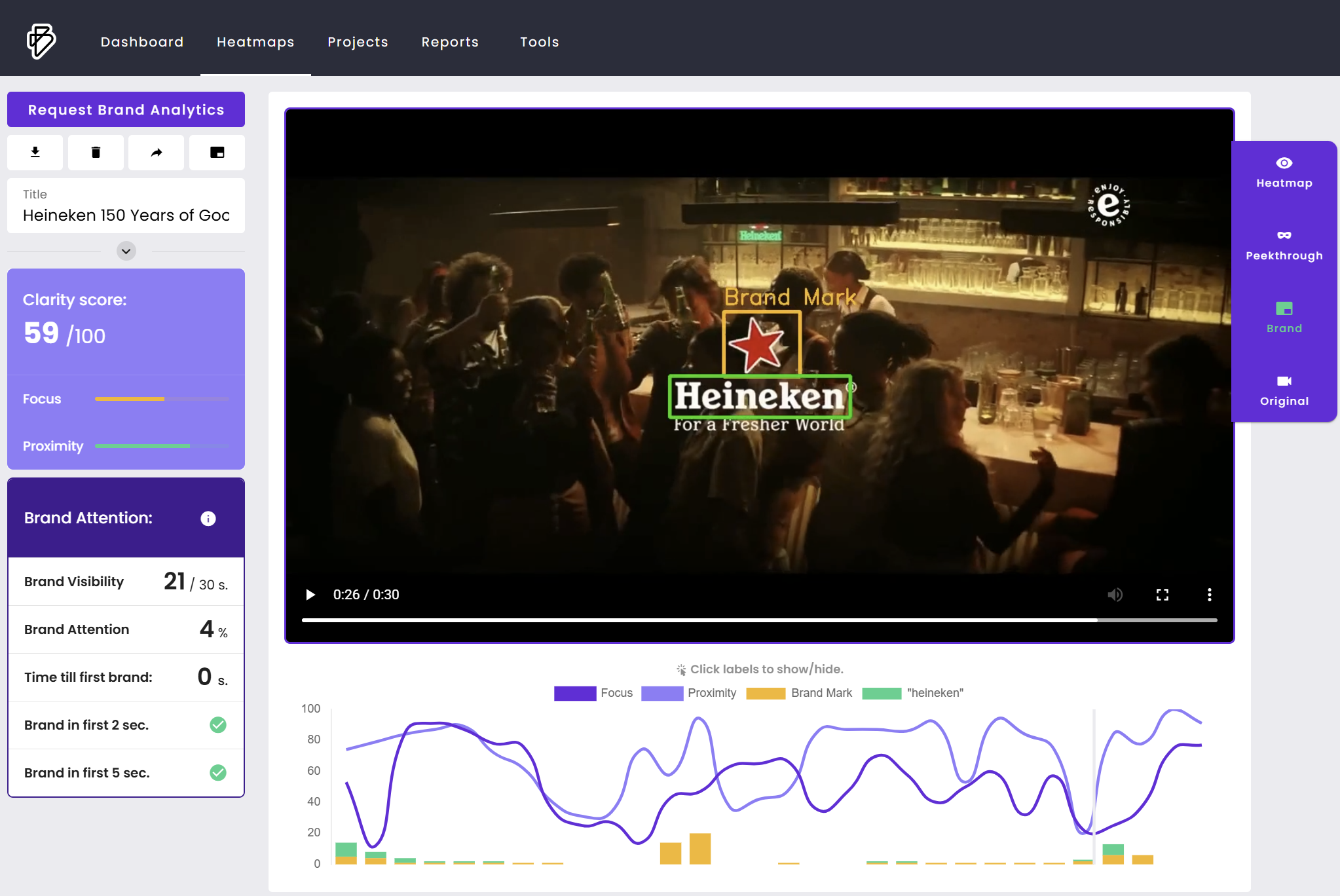
Our platform, Brainsight, maintains a publicly verified accuracy of 94% for instant attention and intuitive viewing behaviour, achieving a "Golden Standard" among AI-based saliency prediction tools. Scientifically, our model is validated to approximate the human 'gold standard' (the leave-one-out approach of human observers) with a confidence of 97%. This extremely high accuracy is achieved by focusing exclusively on Phase 1: the universal instinctive processes (System 1). A key implication of this fidelity is the ability to measure Cognitive Load (how easily or difficult is a visual scene to process), which is quantified and reflected in the Clarity Score. We uphold this accuracy using stringent scientific validation metrics like AUC, CC, and NSS. This 97% figure is a relative score — how closely the model approximates human-to-human agreement on a general, natural-scene benchmark, not an advertising-specific one. Because this number is easy to misread, we lead with the 94% figure: the model's absolute accuracy against live eye-tracking, measured the way the market standard measures it.
Independent Outcome Validation
Model accuracy against eye-tracking data shows the prediction is correct — it doesn't by itself prove the prediction matters commercially. To test that, Brainsight partnered with the University of Amsterdam and Fix Marketing on an independent validation study. 31 display ads, identical in brand assets, format, copy and CTA and varying only in visual composition, were served to over 155,000 impressions on the Google Display Network. Ads scoring 65 or higher on Brainsight's Attention Score (the top third of the benchmark) achieved a 59.6% higher click-through rate than lower-scoring ads (independent samples t-test, p<0.05).
Scientific Partnerships and Credentials
Our solution was developed by a multidisciplinary team at leading neuromarketing agency Braingineers, comprising AI experts, neuroscientists, cognitive psychologists, research experts and engineers. This team leveraged years of expertise and proprietary data gathered in its own live neuroscience lab, utilizing technologies such as Tobii eye-trackers, to establish the foundation for Brainsight. Tobii's hardware is used here as a live eye-tracking validation reference — a different category of technology from Brainsight's predictive AI, which forecasts attention without any hardware or live participants.
Crucially, this development was informed by first-hand experience and real-world data derived from creative / advertising impact and UX projects for global brands and agencies, including ABN Amro, Adyen, Asics, Dentsu, ING, Omnicom Group, KLM, Tobii, TUI, Visa, and Vodafone. This unique combination of academic rigor, proprietary data, and extensive and practical market experience with global brands and use-cases guarantees our technology is built upon both validated science and real-world behavioral knowledge.
Where Predictive Eye Tracking Fits in (and doesn't)
Predictive Eye Tracking focuses on instant viewer attention and subconscious viewing behaviour. It predicts visual probability-, fixation- and processing difficulty, not the subjective mental state of a viewer. The technology (across the board) is fundamentally unable to interpret the content's meaning, aesthetic quality, or whether the creative is perceived as 'good' or 'liked', so it won't predict emotion, memory encoding, purchase intent, or deep understanding. Our article "What Every Marketer Should Know About Predictive Eye-Tracking" goes deeper into the do's and don't of Instant Attention.
As explained earlier, the technology's strength lies in its role as the gatekeeper for engagement triggers, focusing on the critical prerequisites for visual ad performance in the design and creative performance industry.
When pretesting-, validating- and optimizing in the instant attention phase (Phase 1), Predictive Eye Tracking enables:
- Proactive, Data-Driven Insights: intelligence before launch, replacing retroactive click-data and budget with scientific pre-testing.
- Maximum Media Efficiency: optimizing assets for attention (breakthrough in context) and ensuring vital design-elements like CTAs and brand assets are communicated instantly.
- Priming for Engagement & Memory: supporting with insights to actively reduce Visual Clutter, increasing Cognitive Load (ease). This scientific intervention, making the creative to be visually processed more efficiently, primes the user for deeper Phase 2 engagement and maximizing the brain's capacity for memory formation and brand anchoring.
To read more about scientific background of predictive attention / predictive eye-tracking, see the suggested readings. You can also experiment yourself by signing up for a Brainsight (free) Trial.
Suggested readings
More information about Brainsight's Accuracy Rate, Help Section on Interpreting Brainsight's Clarity Score, Article about Why Visual Clarity Is a Make or Break Factor.
The science behind Predictive Eye Tracking and the relation to Advertising and Viewing Behavior is based on decades of academic research in visual saliency, human cognition, and machine learning. Below are some of the most influential studies that have shaped the development of AI-driven attention models:
- Laurent Itti & Christof Koch, A Model of Saliency-Based Visual Attention for Rapid Scene Analysis, University of Southern California (1998)
- Zoya Bylinskii et al., What do different evaluation metrics tell us about saliency models?What do different evaluation metrics tell us about saliency models?, MIT (2018)
- Prof. Karen Nelson-Field, The Attention Economy: Redefining Media MeasurementThe Attention Economy: Redefining Media Measurement, University of Adelaide / Amplified Intelligence (2019)


.mp4%20-%20Heatmap.jpg)