The Rise of Pre-Optimized DOOH: How AI and Attention Data Are Shaping Outdoor’s Next Phase

(as featured in “New Digital Age”)
Outdoor Media has always had a unique power: it reaches people when they’re out in the real world; commuting, shopping, or simply walking past a screen or bus shelter ad. But in a digital-first advertising-world, obsessed with likes, clicks, and impressions, OOH has long faced a painful truth: just being viewable doesn't mean you were actually viewed. And without digital feedback loops, there’s little data to prove what worked, unless you invest in costly post-campaign research.
OOH became DOO, and now, with AI accelerating, 2026 could be the year Outdoor Media truly gets smart.
The Problem with Viewability in Outdoor
There are well-established ways to count and categorize audiences passing a screen at different times of day, so advertisers get a feel for whom they’re advertising to. But there’s no sure way to prove a piece of creative was seen, remembered, or better yet, acted upon.
QR codes offer one workaround — but let’s be honest: scanning a QR code takes effort. It might mean your ad was seen and compelling — or it might just be ignored. Either way, a scan is not a click, and definitely not proof that attention was captured, let alone that it drove behavior.
In digital marketing terms, DOOH offers viewability without verification, unless you’re willing to spend heavily on research.
Real-world relevance: DOOH gets context-aware
Creative can now be swapped and adapted in real time, enabling brands to tailor their messaging based on time of day, location, weather, or other environmental triggers. A rainy morning? A code for umbrellas. A sunny afternoon? Sunscreen or hay fever remedies.
DOOH is no longer static; it’s responsive. This flexibility means campaigns can become more targeted, relevant, and effective, without relying on personal data or intrusive tracking. A powerful evolution in a privacy-focused world.
Pre-optimizing with eye-tracking
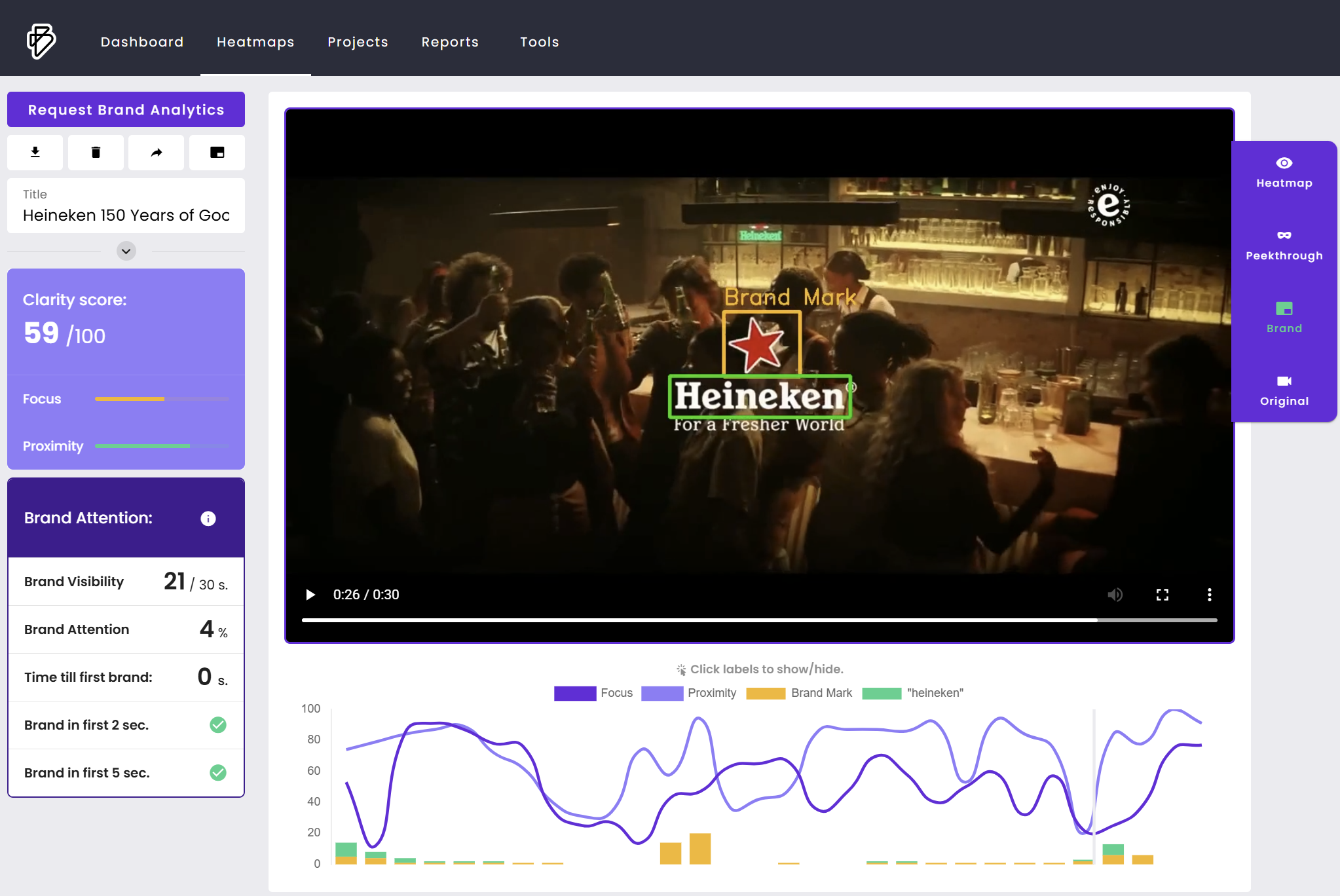
With Predictive Attention on the rise, another part of the OOH challenge is being addressed. This is where Brainsight, our AI-powered predictive eye-tracking platform, is proving revolutionary for brands and agencies, including partners like Dentsu.
Rather than focus on feedback loops that are difficult to build into the physical world, predictive platforms ensure that your DOOH creative is visually effective from the start.
Using neuroscience to simulate how the human eye responds to imagery and text, we help advertisers discover what gets noticed first, and where the viewer’s gaze will go next. In most cases, that means product and context first, followed by brand logo and strapline. Pre-optimisation allows advertisers to validate attention before committing media spend.
Different campaigns, different attention goals
Advertiser requirements vary between campaigns. A branding campaign may want the product or brand name to dominate; a performance campaign may want the discount message to stand out. Being able to achieve both has become more important with programmatic technology that allows (D)OOH sites to show multiple creatives across different moments and settings.
Brainsight enables fast iteration and validation for both brand and performance outcomes.
Privacy-safe channel set for pre-optimized growth
One reason DOOH is gaining traction is its inherent respect for privacy. Previous attempts to integrate cameras or mobile signal tracking around DOOH screens never gained consumer trust (understandably so). Instead, the focus is now shifting: don’t monitor the viewer, but optimize the creative.
Pre-optimisation offers a data-light, privacy-safe way to improve ROI, without crossing ethical lines.
A medium set for growth
The interest in our technology comes at a crucial moment for (D)OOH, just ahead of what is expected to be a year of steady ad market growth. Advertising Association and WARC forecasts show that overall UK ad spend -of which digital formats like DOOH are an expanding share- is expected to rise again in 2026, with total spend projected near £48‑49 bn, according to IAB UK and WARC forecasts (source: IAB.uk). This momentum aligns with the shift toward smarter, privacy‑compliant and outcome‑driven advertising.
HFSS (UK) regulation drives DOOH opportunity?
A further driver is regulation, specifically the UK’s HFSS (High Fat, Sugar, Salt) ad restrictions, which came into effect in 2026. These rules ban online and TV ads for certain foods before 9pm, but do not apply to DOOH. This opens the door for FMCG brands to shift budget towards outdoor, especially in proximity to stores where impulse buying happens. As budgets move to DOOH, advertisers will seek reassurance that their campaigns are working. And that’s where pre-optimised, attention-validated creative comes in.
DOOH’s Next Phase: Smart, Contextual and Pre-Tested
DOOH has gone from static billboards to dynamic, intelligent media. Programmatic delivery, real-time contextual relevance, privacy compliance, and predictive attention are coming together, and 2026 may be the year to make outdoor as intelligent and accountable as digital, without losing its creative power.
It’s a fascinating time for DOOH. As the medium matures, so do the tools around it. At Brainsight, we’re proud to be part of this evolution toward smarter, science-backed creative that earns attention before a single impression is served. Because in DOOH, attention isn’t a guarantee, but with the right tools, it can be designed.
If you're curious, feel free to try it out — your next creative might thank you.